
Introduction
AIA billing is the standardized payment application process built around the American Institute of Architects' G702 and G703 forms. It's how most commercial construction projects handle progress payments.
This guide is written for contractors, subcontractors (including glaziers and glazing companies), and project owners who need to understand how this process works. Get it wrong, and you risk delayed payments, cash flow gaps, and disputes over completed work.
AIA billing shows up on nearly every commercial job, yet details like retainage math, change-order timing, and line-item structure trip people up constantly.
Here's what we'll cover: what AIA billing is, how the process flows step-by-step, what factors affect it, and when it might not fit your project. We'll also point out where software like GlassManager's built-in AIA billing tools can simplify the paperwork.
Key Takeaways
- AIA billing centers on the G702 (payment application) and G703 (continuation sheet) forms
- A Schedule of Values breaks the contract into billable line items with tracked retainage
- The process speeds approvals and reduces disputes when documentation stays consistent
- Subcontractors, including glaziers, benefit most when job costing software connects to the schedule of values
What Is AIA Billing?
AIA billing is a standardized method for submitting and certifying payment applications on construction projects. The American Institute of Architects developed the format decades ago, and it's now the industry standard for monthly payment releases on commercial work.
The goal is simple: produce a verified, itemized record of completed work that justifies exactly how much payment is due for that billing cycle. No guesswork, no vague totals.
How it differs from a regular invoice: A standard invoice just states an amount owed. AIA billing ties every payment request to a pre-agreed Schedule of Values and requires formal certification from the architect or owner before payment moves forward.
Key Documents Behind AIA Billing
Two forms do the heavy lifting:
- G702 (Application and Certificate for Payment): The summary form. It shows contract value, prior billings, current billing amount, retainage, and taxes in one place.
- G703 (Continuation Sheet): The itemized breakdown behind the G702 totals, organized line by line according to the Schedule of Values.
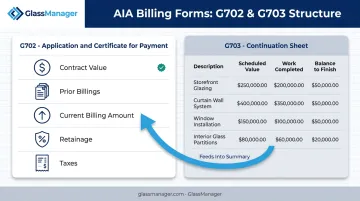
Software like GlassManager automates this step, generating G702/G703 forms directly from your Schedule of Values and cutting hours of manual reconciliation.
Most pay applications also include supporting paperwork: lien waivers, stored-material invoices, change-order logs, and insurance certificates. Exact requirements vary by contract, so always check what your GC or owner expects.
Key Terminology to Know
A few terms come up constantly in AIA billing conversations:
- Retainage (holdback): A percentage of each payment withheld until the project reaches satisfactory completion. It protects owners against unfinished or defective work.
- Schedule of Values (SOV): The itemized cost breakdown that anchors the entire billing cycle. Every line item traces back to this document.
- Stored materials: Materials purchased and on-site (or in a bonded warehouse) but not yet installed. These get billed separately from completed installation work, then shifted into "completed work" once they're actually incorporated into the project.
Why AIA Billing Is Used in Construction
Here's something worth clarifying upfront: AIA billing isn't legally required. No federal or state law mandates the use of G702/G703 forms. It's become the de facto standard simply because architects, general contractors, and lenders recognize and trust it.
That trust matters because large construction projects create a specific payment problem. You've got multiple subcontractors, each billing differently, all requesting payment for partially completed work, and without a shared format, verifying progress becomes chaos.
What typically goes wrong without standardization:
- Mismatched billing formats between trades create confusion during review
- Payment amounts get disputed because there's no agreed reference point
- Approvals stall out due to unclear or incomplete documentation
The core benefits AIA billing delivers:
- Consistent format across every subcontractor and every project
- Regular progress payments that protect contractor cash flow
- Transparent documentation that mitigates payment risk
- Faster review and approval cycles for architects and owners
There's also a dispute-resolution angle that doesn't get enough attention. When disagreements arise over completed work, the Schedule of Values and continuation sheet serve as the agreed-upon reference point. Both parties signed off on the SOV at project start, so it becomes the tiebreaker when conversations get heated.
How AIA Billing Works (Conceptual Flow)
At a high level, the cycle looks like this: work gets completed, measured against the Schedule of Values, compiled into a G702/G703 package, certified, and submitted for payment.
What feeds into the process:
- The original contract sum
- The Schedule of Values
- Prior billing history
- Documentation of work performed during the current period
The contractor calculates the percentage complete for each line item, applies retainage, and totals the amount currently due. Architect or owner certification then confirms the billed amount matches verified work on-site — that's the control point that keeps billing honest.
Once approved, payment is issued, retainage balances update, and the "balance to finish" for each line item recalculates for the next cycle. This repeats at each recurring billing interval, typically monthly, from project kickoff through closeout and final retainage release.
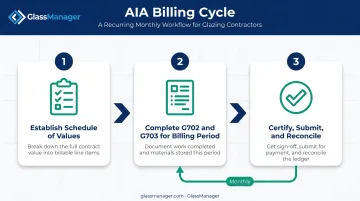
Step 1: Establish the Schedule of Values
The SOV gets created at project start. It breaks the contract into detailed, billable line items that both parties agree on before any billing happens. Skimp on this step, and every future billing cycle inherits the ambiguity.
Step 2: Complete the G702 and G703 for the Billing Period
The contractor fills in work completed, stored materials, and retainage for the current period on the continuation sheet, then rolls those totals up into the G702 summary.
Step 3: Certify, Submit, and Reconcile
The contractor certifies the application. The architect or owner reviews it, approves (or adjusts) the amount, and payment gets issued and reconciled against the running project total.
This is where manual re-entry tends to cause the most errors. GlassManager, for example, connects its Schedule of Values directly to job costing data. Labor, materials, and overhead costs tracked throughout the project flow into the SOV automatically, removing the need for a separate spreadsheet reconciliation.
Change orders update the SOV instantly, and retainage recalculates without manual math. For glazing contractors juggling multiple active pay applications, that connection between estimating, costing, and billing removes a lot of the busywork that used to eat up an afternoon every month.
Key Factors That Affect AIA Billing
Several variables determine how smoothly your AIA billing cycle runs:
- Schedule of Values accuracy: Poorly defined or overly broad line items create ambiguity during review, slowing approval.
- Change order timing: Mid-cycle change orders can create confusion if the approval date doesn't align cleanly with the current billing period.
- Cost code conventions: There's no universal AIA standard for line-item structure, so mismatched formats between contractors and GCs can delay sign-off.
- Retainage percentage and release terms: These vary by contract and jurisdiction. CFMA reports retainage typically runs 5% to 10% of each progress payment.
- State law overrides: State law can override standard retainage ranges. New York, for instance, caps retainage at 5% on covered private contracts.
- Notarization requirements: These vary by state and contract type, so confirm what your specific project requires before submission.
Common Issues, Misconceptions, and When AIA Billing May Not Fit
A few misconceptions cause real problems on job sites.
"AIA billing is legally required." It's not. It's an industry-preferred format, not a regulation. Your contract determines whether it applies.
"Certification guarantees payment." Certification confirms the architect believes the documentation is accurate, that work progressed as billed. It doesn't guarantee the owner pays on time or in full.
"The standard forms fit every project." On complex or highly customized jobs, rigid line-item structures can actually undersell the real complexity of the work. A glazing scope with dozens of glass types, hardware variations, and phased installations doesn't always compress neatly into a handful of SOV rows.
Sometimes a simpler approach makes more sense:
| Billing Method | Best Fit |
|---|---|
| AIA G702/G703 | Multi-month commercial projects with multiple stakeholders |
| Lump-sum invoicing | Fixed-scope jobs with minimal payment complexity |
| Unit-price billing | Work measured by quantity (per square foot, per unit) |
| Simplified invoicing | Small or short-duration projects with few line items |
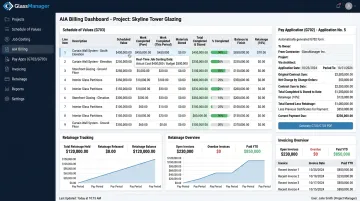
If your team defaults to AIA forms out of habit rather than necessity, that habit adds unnecessary paperwork. Platforms like GlassManager support both AIA progress billing and simpler invoicing formats, so you can match the paperwork to the job instead of forcing every project through the same template.
Conclusion
AIA billing is a standardized, form-based process for requesting and certifying progress payments, built around the Schedule of Values, G702, and G703. Getting the details right matters: accurate line items, correctly timed change orders, and properly tracked retainage directly affect cash flow, dispute risk, and how fast you get paid.
Disciplined, accurate application creates the real value here, not the forms themselves. That's why software connecting estimating, job costing, and invoicing matters.
GlassManager builds AIA-style billing directly into its platform for glazing contractors. Real-time job costs link to the Schedule of Values, so pay applications reflect what's actually happening on the job — not what a spreadsheet said three weeks ago.
Frequently Asked Questions
What is the AIA billing method?
It's a standardized construction payment process using the G702 and G703 forms to request, certify, and track progress payments against a Schedule of Values.
What is the difference between the G702 and G703 forms?
The G702 is the summary application and certificate for payment. The G703 is the itemized continuation sheet that backs up those summary totals with line-by-line detail.
Is AIA billing legally required on construction projects?
No. It's not legally mandated, but it's the widely accepted industry-standard format that owners, architects, and lenders recognize and trust.
How does retainage work in AIA billing?
A set percentage, commonly 5% to 10%, is withheld from each progress payment until the project reaches satisfactory completion, then released according to contract terms.
Can subcontractors like glaziers use AIA billing?
Yes. Subcontractors on AIA-governed projects often submit AIA-style pay applications to general contractors, which makes accurate schedule of values and job costing essential. Platforms like GlassManager help glaziers generate these forms and track job costs without manual spreadsheets.
How is AIA billing different from a regular invoice?
AIA billing ties every payment request to a pre-agreed Schedule of Values and requires certification. A standard invoice skips that structure entirely.