Many glass businesses still rely on spreadsheets, paper job tickets, and phone tag between the office and the field. That gap between old habits and new expectations is exactly where glass technology services come in.
The term covers the technical, scientific, and digital solutions that help glass businesses design, produce, test, and manage their operations. It spans everything from a materials lab testing hydrolytic resistance in pharmaceutical vials to a residential glazier sending a text-message quote from a job site.
This article breaks down the main categories of glass technology services, why they matter for your bottom line, and how software platforms are changing the way glaziers run their businesses day to day.
Key Takeaways
- Glass technology spans three areas: lab testing, manufacturing tech, and business management software.
- Quality compliance and automation cut rework costs and manual errors industry-wide.
- AI-powered quoting cuts glazier estimating time by half or more in documented case studies.
- The right technology partner specializes in glazing, integrates with existing systems, and shows real results.
What Are Glass Technology Services? Defining the Term
"Glass technology services" is an umbrella term. It covers any specialized service or technology that supports the design, manufacture, testing, or business operations of glass products.
What you actually need depends heavily on where you sit in the supply chain. A raw glass manufacturer cares about furnace monitoring and defect detection. A fabricator worries about cutting precision and material handling. A residential or commercial glazing contractor needs software that gets quotes out the door and crews to the right jobsite on time.
Technical & Laboratory Glass Services
This category covers material analysis, mechanical and performance testing, failure analysis, and quality assessment. It's used mostly by manufacturers and suppliers, not installers.
This work follows well-defined regulatory and accreditation standards:
- Pharmaceutical glass packaging relies on USP
<660>tests for surface glass, glass grains, and etching to confirm hydrolytic resistance. - Food and beverage containers get tested under ASTM standards for thermal-shock resistance during washing and pasteurization.
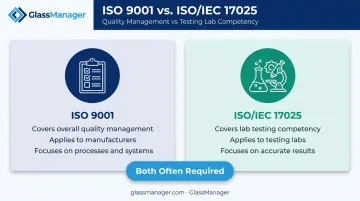
- Labs performing this work typically hold accreditation to ISO/IEC 17025, which demonstrates competent testing and valid results, while manufacturers separately maintain ISO 9001 quality-management certification.
These two standards aren't interchangeable. ISO 9001 covers how an organization manages quality overall; ISO/IEC 17025 proves a specific lab can produce accurate test results. Regulated glass sectors typically need both.
Manufacturing & Process Technology
On the production floor, technology means automation, IoT-enabled furnace monitoring, and immersive training tools like VR simulators for operators running IS machines.
Real-time optical metrology now catches edge chips, cracks, and dimensional errors as they happen, letting manufacturers pull defective output before it moves downstream. That's a meaningful shift from catching problems after the fact.
The broader manufacturing world shows what's possible at scale. The World Economic Forum's Global Lighthouse Network tracks 201 leading industrial sites worldwide, where AI-driven quality initiatives contributed to an average 41% decrease in product defects. Top sites reported reductions above 80%.
That's a cross-industry benchmark, not a glass-specific guarantee. Still, it shows the ceiling for what automation and AI can achieve when applied well.
VR and AR training tools add another layer, letting new operators practice on simulated IS machines before touching real equipment, which reduces both safety risk and costly training downtime.
Business Management & Digital Software Technology
This is where most glazing contractors spend their attention, and it includes CRM, estimating, scheduling, invoicing, and accounting integration built specifically for glass businesses.
AI is changing this space fast. GlassAI, part of the GlassManager platform, takes a vendor's PDF quote and converts it into a customer-ready proposal almost instantly through a simple drag-and-drop upload. Instead of manually re-keying pricing, applying markups, and formatting a proposal, the system extracts the data and builds the quote automatically.
This isn't a hypothetical benefit. GlassManager's internal savings data pegs the quoting speed improvement at roughly 65% faster than manual quoting, translating to over 2.6 hours saved per week and an estimated $7,436 in annual labor savings for a typical team.
Why Glass Technology Services Matter for Glass Businesses
Quality and safety compliance aren't just checkboxes. They affect customer trust and legal exposure directly. A single defective glass panel in a storefront or safety glazing that fails a code inspection can trigger liability claims that dwarf the cost of proper testing.
The Cost of Manual Errors and Rework
Rework is where this shows up financially across construction-adjacent trades. The Construction Industry Institute found that rework typically costs 2% to 20% of contract value, depending on how well a project is managed. For a glazing contractor running six-figure commercial jobs, that range represents real money lost to preventable errors.
Digitizing manual processes closes much of that gap. McKinsey's research on construction digitization found that digital tools can drive 14% to 15% productivity gains and 4% to 6% cost reductions across engineering and construction firms. One contractor in McKinsey's study cut rework hours by 12% simply by tagging defects on mobile devices tied to a shared data system.
Proof From Glass Businesses Using GlassManager
Glass businesses adopting GlassManager see similar patterns play out on the ground:
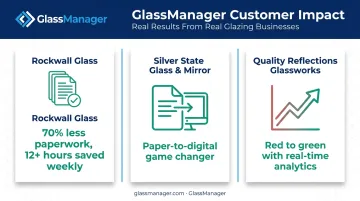
- Rockwall Glass cut paperwork by 70% and freed up more than 12 hours per week after automating manual processes.
- Silver State Glass & Mirror moved off a fully paper-based system and reported saving significant time and money, with owner Eric Hooiman calling the shift "a game changer."
- Quality Reflections Glassworks used real-time analytics and tighter accounting alignment to go, in their words, "from red to green."
Beyond cost savings, technology creates a genuine competitive edge. Faster quotes win more jobs simply because customers often go with whoever responds first. Real-time dashboards give owners visibility into job costing across office, shop, and field teams instead of waiting for month-end reports to find out a job lost money.
Cash flow benefits too. Faster invoicing and built-in online payment processing shorten the gap between finishing a job and getting paid for it, which matters enormously for smaller glazing shops operating on thin margins.
Key Types of Technology Services Every Glazing Business Should Know
Not every glass business needs a materials testing lab. Nearly all of them, though, benefit from these six categories of software.
Estimating & Quoting Software. Digital and AI-powered quoting tools shorten proposal turnaround from hours to minutes. GlassAI's vendor-quote-to-customer-proposal conversion is a direct example: upload a supplier's PDF, get a branded, marked-up quote back in seconds instead of manually rebuilding it.
CRM & Customer Lifecycle Management. These tools track leads from first inquiry through final payment, so nothing falls through the cracks between an initial phone call and a signed invoice.
Scheduling & Mobile Field Management. Mobile apps let technicians pull up job details, update statuses, and coordinate with the office without constant phone calls. This keeps field crews and dispatchers on the same page even on busy install days.
Inventory & Purchase Order Management. Real-time visibility into materials and labor costs supports accurate job costing at every stage, from initial estimate to final billing, instead of discovering cost overruns after the job wraps.
Accounting Integration. Syncing financial data with platforms like QuickBooks or Sage 50 eliminates duplicate entry between job management software and the books. Fewer manual entries means fewer bookkeeping errors.
Integrated Communication Tools. Built-in SMS and messaging features keep customers and internal teams aligned inside one platform. GlassManager's two-way SMS chat, for instance, lets a customer text a broken-window request while a rep responds with photo requests and scheduling, all in one thread. Internal Messenger group chats keep install crews coordinated on deliveries and approved quotes without switching to outside apps.
How to Choose the Right Glass Technology Service Partner
Not all software vendors understand glazing. Here's what actually separates a good fit from a bad one.
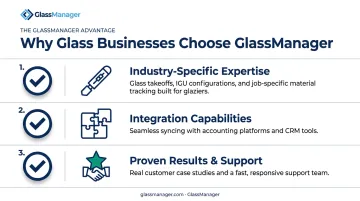
Industry-specific expertise over generic tools. A platform built for general contractors will miss glazing-specific needs like AIA progress billing, retainage tracking, or glass-and-hardware line-item breakdowns. Look for vendors who build exclusively for glass and glazing businesses.
Integration capabilities. Check whether the platform connects cleanly with your existing accounting software, supplier catalogs, or CRM. Duplicate data entry between disconnected systems defeats the purpose of going digital in the first place.
Proven results and responsive support. Ask for real case studies, not just marketing claims. Quality Reflections Glassworks' documented "red to green" turnaround is the kind of measurable outcome worth demanding from any vendor you consider.
Support responsiveness matters more than it seems. A quoting error on a Friday afternoon job doesn't wait for Monday's support ticket queue.
Frequently Asked Questions
What are the 4 types of glass?
The four common types are:
- Float/annealed glass: Standard flat glass for general glazing
- Tempered glass: Heat-strengthened for safety applications like doors and showers
- Laminated glass: Bonded layers that hold together when broken, used in security and overhead glazing
- Insulated glass: Sealed multi-pane units for energy efficiency in windows
What is the difference between glass technology services and glass software?
"Glass technology services" is the broad umbrella covering everything from lab testing to manufacturing automation to business software. "Glass software" refers specifically to digital tools like CRM, estimating, and scheduling platforms used to run daily operations.
Do small glazing businesses need glass technology services?
Yes. Even a two-person glass shop benefits from basic scheduling and invoicing software, since it cuts administrative time and helps compete against larger, better-organized competitors.
How much do glass technology services typically cost?
Costs vary widely by service type. Lab testing is billed per test or project, while business software like GlassManager uses tiered subscription pricing (Lite, Pro, Enterprise) based on features and team size.
What industries rely most on glass technology services?
Pharmaceutical packaging, food and beverage containers, architectural glazing, and automotive glass all depend heavily on specialized testing and technology, each with distinct regulatory and performance requirements.
How is AI changing glass quoting and estimating?
AI tools like GlassAI convert vendor quotes into customer-ready proposals almost instantly, cutting manual data entry and speeding up turnaround. GlassManager's internal data shows this can reduce quoting time by roughly 65% for glazing teams.