Introduction
A supplier invoice lands in the inbox for a custom glass order. Before anyone pays it, someone in the office has to confirm the pricing, quantity, and glass specs actually match what was ordered. That verification step is invoice-to-PO matching.
It sounds like a simple line-by-line comparison. In practice, results vary enormously. Whether the match happens by hand on a spreadsheet or through a connected system makes a big difference. So does how well the original purchase order was documented in the first place.
This guide covers:
- What invoice-to-PO matching actually involves
- The difference between 2-way, 3-way, and 4-way matching methods
- A step-by-step process you can put into practice this week
- The mistakes that trip up glaziers most often
- How automation protects your margins as your supplier list grows
Key Takeaways
- Invoice-to-PO matching verifies invoices against POs and receipts before payment goes out
- Three matching levels exist: 2-way, 3-way, and 4-way, based on order size, material type, and risk
- Manual matching gets error-prone fast with multiple suppliers, custom cuts, and split deliveries
- Tolerance thresholds and connected software catch discrepancies before they inflate job costs
What Is Invoice-to-PO Matching?
Invoice-to-PO matching is the process of comparing a supplier's invoice against the original purchase order, and sometimes a delivery or packing slip, to confirm pricing, quantities, and materials before you release payment. Three documents typically come into play:
- The purchase order — what you agreed to buy, at what price, in what quantity
- The supplier invoice — what the vendor is billing you for
- The delivery/packing slip — proof of what actually showed up (used in 3-way matching)
For a glazing business, this isn't an abstract accounting exercise. Glass pricing shifts based on thickness, coating, tempering, and size, and a single commercial job might pull materials from three or four suppliers on staggered delivery schedules.
A mismatch buried in one invoice line can inflate a job's material cost without anyone noticing until the project is already unprofitable.
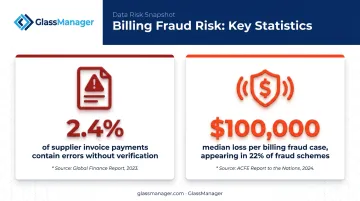
The stakes are real across industries, not just glazing. According to IOFM's benchmarking research, an average of 2.4% of supplier-invoice payments contain errors when no verification step catches them first.
On the fraud side, the Association of Certified Fraud Examiners' 2024 Report to the Nations analyzed 1,921 cases worldwide. Billing schemes appeared in 22% of them, with a median loss of $100,000 per case.
Skip the matching step, and here's what tends to happen:
- You overpay for materials that were billed at the wrong price or quantity
- You pay for glass panels or hardware that never actually arrived
- Your job costing drifts away from what the project is actually earning
Types of PO-Invoice Matching
Not every purchase order deserves the same scrutiny. A box of glazing points doesn't need the same review as a $40,000 curtain wall glass package. The right matching method depends on transaction size, risk, and how complex the order is.
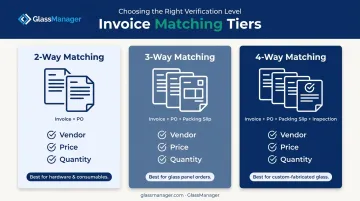
2-Way Matching
This method compares only the invoice against the PO, checking vendor, price, and quantity. No receiving document is involved. It works well for:
- Hardware and small tools
- Consumables like sealants or cleaning supplies
- Low-dollar, low-risk purchases where speed matters more than deep verification
- Repeat orders from vendors with a reliable delivery history
The trade-off: because there's no receiving check, you're trusting that the billed quantity matches what actually showed up. Fine for a $200 hardware order. Risky for a full pallet of laminated glass.
3-Way Matching
3-way matching adds a delivery receipt or packing slip to the mix, confirming the goods were actually received before payment clears. This is the better fit for:
- Larger glass panel orders
- Shipments coming in from multiple suppliers
- Split or partial deliveries, which are common when big glazing orders arrive in batches
If a shipment shorts you three panels but the invoice bills for the full quantity, 3-way matching is what catches it.
4-Way Matching
4-way matching adds a fourth checkpoint: a quality or inspection step. This matters most for custom-fabricated or specialty coated glass, where the product needs to meet spec, not just arrive in the right quantity, before payment is approved.
If a low-E coating batch arrives with the wrong tint or a fabrication tolerance is off, this step catches it before the invoice gets paid.
Which method should you start with? Most small-to-midsize glazing shops do fine starting with 2-way matching for routine hardware and consumables. Layer in 3-way matching as order size, supplier count, or shipment complexity grows, particularly for glass panel orders where partial deliveries are the norm rather than the exception.
Step-by-Step: How to Match an Invoice to a Purchase Order
Step 1: Organize and Reference the Purchase Order
Before the order ships, confirm the PO number, vendor details, and every line-item spec are documented — glass type, dimensions, quantity, and price. A PO with vague line items ("misc. glass, per quote") gives you nothing solid to match against later.
Step 2: Capture the Invoice When It Arrives
Record the invoice date, the PO number it references, and the line items exactly as billed, whether it arrived by email, PDF, or paper. Don't summarize or round; capture it as written.
Step 3: Compare Header-Level Details
Before diving into line items, check that the vendor name, PO number, and total amount due line up between the invoice and the PO. If the header doesn't match, there's no point reviewing the details underneath.
Step 4: Compare Line-Item Details and Delivery Records
Verify that quantities, pricing, and material specs match. If the order shipped in partial batches, cross-check each shipment against the packing slip:
- Does the billed quantity match what was ordered on the PO?
- Does it match what was actually delivered?
- Are pricing and material specs (thickness, coating, tint) consistent across all three documents?
Step 5: Resolve Discrepancies or Approve for Payment
Any mismatch gets flagged and investigated with the supplier before payment goes out. Invoices that check out cleanly move forward for approval right away. Don't let a discrepancy sit unresolved while payment terms tick down.
Common Mistakes to Avoid When Matching Invoices to POs
A handful of errors show up again and again in glazing shops, and most trace back to inconsistent process rather than bad intentions.
- Loose unit comparisons: glass billed by square foot on the invoice but per panel on the PO creates false mismatches or, worse, hides a real pricing error
- Skipping review on rush or verbal orders: when a formal PO never gets documented, there's nothing solid to match the invoice against later
- Losing track of partial deliveries: large glass orders that ship in multiple batches can result in paying twice for one shipment or missing a shortage entirely
- Inconsistent process across staff: when matching quality depends on who happens to process the invoice that day, discrepancies slip through unevenly
Standardizing the match process, rather than relying on memory or verbal agreements, closes most of these gaps.
Why Glass & Glazing Businesses Should Automate PO Matching
Manual matching works fine when you've got one or two suppliers and a handful of jobs running. It stops working once your supplier network expands and job volume climbs: more invoices, more line items, more chances for something to slip through unnoticed.
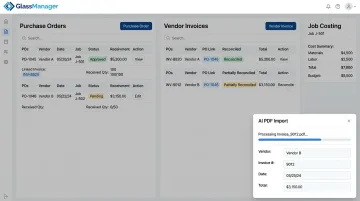
GlassManager's Purchase Orders and Vendor Invoices modules keep this connected instead of scattered across paper files and spreadsheets. Within the platform, you can:
- Link vendor invoices directly to the purchase orders they belong to, rather than tracking the relationship manually
- Use AI-powered PDF import to pull invoice data automatically instead of retyping it
- Reconcile vendor invoices against POs to quickly check whether amounts, quantities, and prices line up
- Record received quantities against each PO line item as shipments arrive, supporting partial and split deliveries
Because purchase orders, vendor invoices, and jobs are linked in one system, a pricing or quantity discrepancy is easier to catch before it erodes a project's margin. Material costs tie straight back to the job they belong to.
This functionality scales with the business. The Pro plan unlocks full PO management, vendor invoice reconciliation, and AI-powered PDF extraction — the tier where most growing shops see the real automation payoff.
The Lite plan covers customer-facing invoicing only, while Enterprise adds custom integrations for businesses connecting these workflows to external accounting or ERP systems.
| Capability | Lite | Pro | Enterprise |
|---|---|---|---|
| Customer Invoicing | ✅ | ✅ | ✅ |
| Purchase Orders | ❌ | ✅ | ✅ |
| Vendor Invoice Matching | ❌ | ✅ | ✅ |
| AI PDF Invoice Extraction | ❌ | ✅ | ✅ |
| Custom Integrations | ❌ | ❌ | ✅ |
The value of getting this right shows up industry-wide, too. Ardent Partners' 2024 benchmarking research found that top-performing accounts payable teams had 78% lower per-invoice processing costs and a 59% lower invoice-exception rate than the rest of the market. That gap starts with how consistently invoices get matched against what was actually ordered and received.
Frequently Asked Questions
What is the purchase order matching process?
It's the process of comparing invoice details and delivery records, if used, against the original PO to confirm accuracy before payment is approved. It catches pricing or quantity errors before money changes hands.
Should a purchase order match an invoice?
Yes. Matching is standard practice to avoid overpayments and to ensure you only pay for what you actually ordered and received, not just what a supplier decided to bill.
What happens if a purchase order does not match an invoice?
AP flags the invoice as a discrepancy and holds payment until staff investigate with the supplier. Once the difference is resolved, the invoice moves forward for payment.
What is the difference between 2-way and 3-way matching?
2-way matching checks the invoice against the PO only: vendor, price, and quantity. 3-way matching adds the delivery receipt or packing slip to confirm the goods were actually received.
Do small glass and glazing businesses need 3-way matching?
Smaller shops with simple, low-risk purchases can often rely on 2-way matching alone. 3-way matching becomes worth the extra step as order size, supplier count, or shipment complexity grows.
Can invoice-to-PO matching be automated?
Yes. Platforms like GlassManager connect purchase orders and vendor invoices within one system, letting you reconcile amounts, quantities, and prices without relying on manual line-by-line checks across spreadsheets.