34% of small and medium businesses still track inventory manually, and another 24% rely on spreadsheets, according to Capterra's 2026 buyer research. Half of the businesses that eventually ditch spreadsheets say it's because the process became too inefficient to sustain.
Inventory software has moved well past simple stock counts. Modern platforms now offer AI-driven demand forecasting, real-time visibility across multiple warehouses and job sites, and integrations that sync directly with accounting and CRM tools.
This guide breaks down the top general-purpose inventory platforms of 2026. We'll also cover why trade-specific businesses, like glass and glazing contractors, often need something built specifically for how they work.
Key Takeaways
- Top 2026 platforms combine AI forecasting, barcode/serial tracking, and native accounting integrations
- Compare total cost of ownership, not just sticker price, across free-to-enterprise tiers
- Nearly 9 in 10 disappointed software buyers cite implementation problems, not the software itself
- Generic tools often can't handle trade-specific needs; platforms like GlassManager add materials and vendor tracking built for glazing shops
Overview of Inventory Management Software in 2026
Inventory management software is a digital system for tracking stock levels, movement, and valuation across warehouses, retail locations, trucks, and job sites. At its simplest, it answers three questions:
- What do you have
- Where is it
- What it's worth
Answering those questions has become big business. Grand View Research values the global inventory management software market at $3.9 billion in 2026, climbing to an estimated $7.1 billion by 2033 — an 8.9% annual growth rate.
That growth has produced dozens of general-purpose platforms. Some specialize in retail, others in manufacturing, and a few try to do everything at once. The "best" one depends entirely on your business type, which is exactly what the next section breaks down.
Top Inventory Management Software of 2026
We evaluated each platform against four criteria: reliability, integration depth, scalability, and how real customers rate their experience across industries. Here's how the leading options stack up.
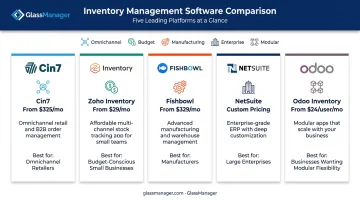
Cin7
Cin7 is a cloud-based platform built for omnichannel brands that need inventory, POS, warehouse, and B2B order management working in sync. It's particularly strong for businesses selling across multiple channels at once.
Differentiators: Real-time stock sync across connected sales channels, EDI support for retail partnerships, and demand planning tools designed for fast-scaling wholesale operations.
| Category | Details |
|---|---|
| Pricing | Core Standard starts at $349/month; Pro at $599/month; Advanced at $999/month |
| Key Features | Omnichannel stock sync, built-in POS, B2B customer portal, batch tracking |
| Best For | Fast-scaling retail, wholesale, and warehouse-driven businesses |
Zoho Inventory
Zoho Inventory is the budget-friendly entry point into the Zoho software ecosystem. It's built for businesses that need multi-channel selling without enterprise-level complexity or cost.
Differentiators: Fast onboarding, automatic sync with Amazon, eBay, Etsy, and Shopify, plus tight native integration with Zoho CRM and Zoho Books.
| Category | Details |
|---|---|
| Pricing | Free plan available; Standard starts at $29/organization/month billed annually |
| Key Features | Automated reorder points, shipping integrations, multi-channel marketplace sync |
| Best For | Small to mid-sized retail and e-commerce businesses moving off spreadsheets |
Fishbowl
Fishbowl has long been a go-to for manufacturers who need bills of materials, work orders, and job costing baked into their inventory system, not bolted on as an afterthought.
Differentiators: Two-way QuickBooks Online and Desktop sync, plus strong support for multi-level BOMs and subassembly tracking in production environments.
| Category | Details |
|---|---|
| Pricing | Essentials starts at $229/month billed annually for 2 users; implementation package required |
| Key Features | BOM management, work orders, asset tracking, native QuickBooks integration |
| Best For | Custom manufacturers and production-focused businesses |
NetSuite Inventory (Oracle)
NetSuite's inventory module is part of a full ERP suite, giving large organizations end-to-end supply chain visibility, from raw material sourcing through delivery.
Differentiators: Lot and serial traceability that follows items from supplier through manufacturing to customer, plus AI-powered analytics for high-volume, high-complexity operations.
| Category | Details |
|---|---|
| Pricing | No public price; custom quote based on modules, users, and implementation scope |
| Key Features | Multi-warehouse fulfillment, demand-based replenishment, cycle counting |
| Best For | Large enterprises with global operations and compliance requirements |
Odoo Inventory
Odoo takes a modular, open-source approach. Businesses can start with a free inventory app and add modules as they grow, rather than committing to a full suite upfront.
Differentiators: Highly customizable barcode workflows, smart routing logic, and a lower cost structure than most full-suite competitors offer.
| Category | Details |
|---|---|
| Pricing | One App Free ($0); Standard $24.90/user/month; Custom $49/user/month, billed annually |
| Key Features | Barcode scanning, replenishment automation, modular add-ons |
| Best For | SMEs planning long-term digital transformation on a budget |
None of these five platforms were built for trade-specific inventory needs, where materials tracking has to tie directly into estimating and job costing. Businesses in specialized trades, like glass and glazing, often get more value from industry-built platforms such as GlassManager, which manages materials and inventory alongside quoting, purchase orders, and job costing in one system.
Why Industry-Specific Inventory Software Matters for Glass & Glazing Businesses
Generic inventory platforms are great at tracking SKUs and unit counts. They fall apart the moment a business deals in square footage, custom cut sizes, or vendor-specific glass pricing, which is exactly the reality for glaziers.
Glass isn't sold like widgets:
- Materials get priced and cut by minimum square footage, not fixed units
- The same glass type carries different cost and sell prices depending on the supplier
- Hardware often ships in reels, packs, or cases, not single units
- A base glass panel might need edge work, tempering, or other fabrication before it's job-ready
Standard warehouse tools simply don't have a concept for any of this. GlassManager was built specifically to handle exactly these scenarios.
An All-in-One Platform Built for Glaziers
GlassManager unifies inventory with CRM, estimating, purchase orders, and job costing in a single system. Its materials database supports flexible unit configurations (cases, reels, individual panels), vendor-specific cost and sell pricing, and links between base materials and their fabrication add-ons.
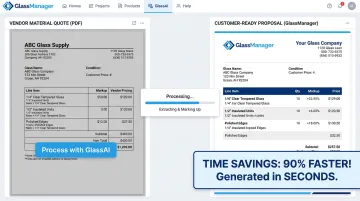
One standout feature is GlassAI, which converts vendor material quotes into customer-ready proposals in seconds. Instead of manually reading a vendor PDF and retyping pricing into a separate quote, the AI extracts line items automatically and applies your markup and branding. GlassManager's own ROI calculator estimates this can cut quoting time by 65%, saving businesses roughly 2.6 hours per week.
Real-Time Job Costing, Without the Guesswork
Winning the job faster is only half the story; what happens after the quote is accepted matters just as much. Purchase orders, vendor invoices, and timesheets all connect to the same job record, giving owners visibility into labor, materials, and overhead as a project moves forward, not just after the invoice goes out. That kind of real-time tracking is what stops margin erosion before it happens, rather than catching it in a post-mortem.
Quality Reflections Glassworks put it simply: "GlassManager helped us go from red to green. It's the backbone of our evolving operation." Silver State Glass & Mirror reported similar results, with owner Eric Hooiman noting they moved off a paper-based system and now "save a ton of time and money."
GlassManager scales through Lite, Pro, and Enterprise tiers, so glass businesses can add inventory management, purchase orders, and progress billing as they grow rather than paying for capabilities they don't yet need.
How We Chose the Best Inventory Management Software
The most common buying mistake is prioritizing sticker price over integration depth, scalability, and industry fit. This tradeoff usually ends in a costly platform switch a year or two later.
That risk is well-documented. According to Capterra's 2026 software buying research, nearly 9 in 10 disappointed buyers experienced implementation disruption, with integration issues (40%), migration errors (38%), and rollout delays (38%) as the top culprits.
We scored each platform against five factors:
- Integration capability: Does it connect natively to your accounting, CRM, and sales channels?
- Forecasting and automation depth: Can it predict demand and automate reordering, or does it just report what already happened?
- Customer support responsiveness: How fast can you get a real answer when something breaks?
- Scalability: Will it still fit your workflow at 3x your current size?
- Total cost of ownership: Does it account for setup fees, per-user pricing, and implementation costs, not just the advertised starting rate?
Each factor ties directly to outcomes that matter: fewer stockouts, tighter cash flow, and less time spent fixing avoidable errors.
Conclusion
The best inventory management software in 2026 is simply whichever tool fits your specific operation, based on your industry, team size, and how deeply it needs to connect with the tools you already use.
Before committing, test drive your shortlist. Run a free trial or demo against your actual workflows, not just a sales deck, and ask hard questions about scalability and support quality.
If you're a glass or glazing business currently forcing a generic tool to handle square-footage pricing and vendor-specific costs, see what a purpose-built platform can do. Request a GlassManager demo to see inventory, estimating, and job costing working together in one place.
Frequently Asked Questions
What is a good inventory tracking software?
A good inventory tracking tool offers real-time stock visibility, barcode or serial tracking, low-stock alerts, and integrations with your accounting or CRM system. The right choice ultimately depends on your business size and industry.
What features should I look for in inventory management software in 2026?
Prioritize AI-driven forecasting, multi-location tracking, native integrations with your existing tools, and solid reporting. Automation depth matters more than a long feature checklist.
How much does inventory management software typically cost?
Pricing spans a wide range, from free tiers to $500+ per month for enterprise-grade platforms. Cost is generally driven by user count, feature depth, and how complex your business operations are.
Is cloud-based inventory management software secure?
Most modern platforms use encryption, regular backups, and role-based permissions to protect data. These safeguards have made cloud-based systems the standard choice for businesses of all sizes.
What's the difference between generic and industry-specific inventory software?
Generic tools track standard SKU-based stock well but miss trade-specific needs. Industry-specific platforms like GlassManager handle unique measurement units, material types, and job-costing workflows relevant to that trade.
Can inventory management software integrate with accounting and CRM systems?
Yes, most reputable platforms offer these integrations. GlassManager, for example, syncs with QuickBooks Online, QuickBooks Desktop, and Sage 50 to keep financial and job data aligned automatically.