By 2026, the shift is unmistakable: generic, disconnected tools are giving way to smarter, more specialized platforms built for how specific trades actually operate. General contractors want AI-assisted estimating. Specialty trades, glaziers, electricians, and other subcontractors, want software that speaks their language instead of forcing them into workflows designed for someone else's job.
Understanding these trends isn't just interesting reading. It's how you avoid wasting money on the wrong tech stack while competitors pull ahead on speed and client experience.
Key Takeaways
- AI-powered estimating cuts proposal turnaround from days to hours
- All-in-one platforms replace scattered tools and end double data entry
- Mobile-first field apps with GPS tracking and offline sync are now standard, not optional
- Trade-specific software beats generic tools for specialty contractors like glaziers
- Built-in client communication now helps contractors win and keep more jobs
Key Trends Shaping Construction Apps in 2026
AI-Powered Estimating, Quoting, and Bidding
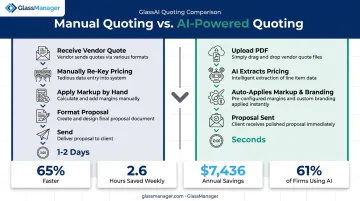
Manual quoting has always been the bottleneck between a lead and a signed job. A contractor gets a vendor quote, manually re-keys the pricing, applies markup by hand, formats a proposal, and sends it, often a day or two later.
AI is collapsing that timeline. Instead of retyping numbers from a PDF, contractors upload the vendor quote directly, and the software extracts pricing, applies custom markups and branding, and produces a client-ready proposal automatically.
GlassManager's GlassAI is a working example built specifically for glass and glazing contractors. The tool converts vendor quotes into finished customer proposals in seconds rather than hours, using drag-and-drop PDF import.
Based on GlassManager's ROI modeling, quoting through the platform runs 65% faster than manual methods. That translates to roughly 2.6 hours saved per week and an estimated $7,436 in annual savings for a typical shop.
Similar AI estimating features are showing up across general contractor platforms too. According to AGC's 2026 Construction Hiring and Business Outlook, 61% of firms now use AI or plan to increase AI investment, up from 44% just a year earlier, with 23% already applying it directly to estimating. That's a real jump in one year, not hype.
AI isn't taking over estimating jobs. It's removing the repetitive re-entry work, freeing estimators to focus on pricing strategy and client relationships.
All-in-One Platform Consolidation
Juggling five different apps for scheduling, invoicing, and customer records creates a specific kind of pain: the same job information gets typed in three or four times, and something always falls through the cracks.
The market response is consolidation. Instead of stitching together point solutions, contractors are moving to platforms that centralize the entire job lifecycle, from first client contact through final payment.
Rockwall Glass offers a concrete before-and-after. After consolidating operations onto a single platform, owner Ronnie reported:
"I was spending most of my day just filling out paperwork. GlassManager changed everything."
The measurable results:
- 70% reduction in paperwork
- 12+ hours per week freed up across two installation crews
- Faster handoffs between field crews and the office
Quality Reflections Glassworks saw a similarly dramatic shift. Owner Guillermo Ramirez described going "from red to green," crediting the platform's aligned operations and accounting data with turning a losing operation into a profitable one.
A Glasco reported "slashing data-entry time" after combining both commercial and residential workflows onto one system.
The pattern is consistent: disconnected software leads to duplicate work, and duplicate work costs teams hours of manual reconciliation every week.
Mobile-First Field Management and Real-Time Jobsite Visibility
Field crews live on their phones now, rarely opening a laptop on site. Verifying labor hours, tracking job progress, and confirming who's where has moved almost entirely to mobile apps.
GPS-enabled time tracking is a good example of how this plays out in practice. GlassManager's mobile app uses location-verified clock in/out, meaning every timesheet entry ties back to a captured GPS location at the moment a technician clocks in or out. Crews can:
- Clock in and out with one tap, automatically updating job status to "In Progress"
- Attach time entries to a specific project, work order, or labor category
- Submit digital timesheets from the field, skipping the office trip entirely
Offline functionality matters just as much as GPS accuracy. Job sites don't always have reliable signal, so crews need to keep working regardless. GlassManager's mobile app lets field teams access job details, work orders, and punch lists offline, then automatically syncs everything, notes, photos, task updates, once connectivity returns.
Smart route planning and job location mapping round out the picture, helping dispatchers reduce windshield time and keep crews moving between jobs efficiently. Mobile field management has become the baseline expectation for any contractor managing more than a couple of crews.
Vertical, Trade-Specific Software for Specialty Contractors
Generic construction management software is built for the average job: lumber, concrete, drywall. It often has no idea what to do with glass dimensions, IGU specifications, or hardware fabrication notes, because it was never designed for those workflows.
That gap is exactly why vertical, trade-specific platforms are gaining ground. GlassManager, purpose-built exclusively for residential and commercial glaziers, illustrates the difference clearly:
- Glass-specific materials management with fields for material description, category, part number/size, supplier, cost, and sell price, mapped to real glass types like 1/4" MIRROPANE or 1/8" Clear Double Strength
- **Floor plan and blueprint tools** that let estimators upload a PDF plan, pin openings and installation details directly onto it, and convert those pins into trackable tasks
- A drawing tool with templates for hinges, cut-outs, and fabrication notes, attached directly to estimates and work orders
- Multiple billing structures including standard jobs, progress billing, and AIA-style billing for larger commercial contracts
None of this exists in a generic platform because generic platforms weren't built around how a glazier actually measures, quotes, and installs. The same logic applies across other specialty trades: electricians need panel schedules and circuit data, plumbers need fixture counts, and none of it fits neatly into one-size-fits-all software.
Integrated Communication and Client Experience Tools
Scattered emails, missed calls, and texts sent from a personal phone create real business risk: lost context, delayed responses, and no record of what was actually promised.
Built-in communication tools are closing that gap. GlassManager's two-way SMS chat lets office staff text clients directly from within the platform, sharing quotes, photos, and documents in the same thread. A customer can text a photo of broken glass, and the rep can respond, request details, and generate a quote without ever switching apps.
The internal side matters too. Group chats (like "Install Crew" or "Sales") keep field and office teams aligned on deliveries, approvals, and project documents, while direct messages handle one-off questions. Estimates, jobs, and invoices can be created directly from a chat thread, so conversations turn into billable work without a platform switch.
Faster response times have become a competitive requirement for contractors competing on service quality. This kind of built-in communication removes the friction that causes leads to go cold and customers to feel ignored.
What's Driving These Construction App Trends
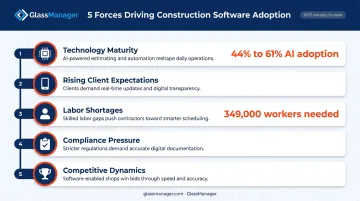
Several forces are converging at once, and they're reinforcing each other rather than acting independently.
- Technology maturity: AI tools have moved from experimental to practical fast, with AGC data showing a jump from 44% to 61% of firms using or investing in AI in just one year.
- Rising client expectations: Clients accustomed to real-time tracking in other parts of their lives now expect the same from contractors: digital approvals, live status updates, and instant quotes.
- Labor shortages: ABC estimates the industry needs 349,000 net new workers in 2026, and AGC found 92% of firms already struggle to find qualified workers. Software matters more when you can't hire your way out of the gap.
- Compliance pressure: Digital recordkeeping requirements for safety (OSHA electronic reporting) and payroll (certified payroll under Davis-Bacon) are pushing firms away from paper-based processes that are harder to audit and easier to lose.
- Competitive dynamics: Firms using modern software win bids faster and look more credible to clients than competitors still quoting off a clipboard.
How These Trends Are Impacting Construction Businesses
Operational Impact
Workflows are shifting from paper-based and siloed to centralized and real-time. Data flows between field and office instead of getting keyed in twice.
The practical result: less time on manual data entry, invoicing, and chasing status updates, and more time on billable work. Rockwall Glass's 70% paperwork reduction shows what this looks like in practice.
Business Impact
Strategically, firms are shifting spend from one-off tools toward ongoing software subscriptions, with accounting integration becoming a non-negotiable requirement rather than a bonus feature.
The payoff can be substantial, but it depends heavily on how well a firm implements the tools. A 2025 Dodge study, conducted with Procore, found that among highly skilled software users, 83% reported overhead reductions of at least 5%, and 77% reported higher profit margins, with a median 4-point margin increase.
Silver State Glass & Mirror's experience reflects this pattern. Owner Eric Hooiman described moving off a paper-based system as a "game changer," citing time and money saved through faster quoting, better scheduling, and accurate invoicing.
Workforce Impact
Field staff now need basic digital literacy. Using mobile apps, digital forms, and time clocks isn't optional anymore. Firms are adjusting hiring and training accordingly, looking for staff comfortable with software-driven reporting rather than assuming paper-based habits will transfer.
This is a real shift in what "qualified" means for field roles, not just an IT department concern.
Future Signals for Construction Apps in the Industry
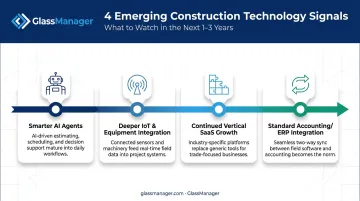
Trends keep evolving. Here's what's worth watching over the next one to three years:
- Smarter AI agents: Early deployments already show AI handling more than static quoting. Skanska and Gilbane use AI assistants to search thousands of project documents and support scheduling decisions. This points toward automated conflict resolution and predictive delay warnings ahead.
- Deeper IoT and equipment integration: Sensor data on equipment condition, temperature, vibration, and location is starting to feed predictive maintenance alerts, catching problems before they cause downtime.
- Continued vertical SaaS growth: Expect more trade-specific platforms tailored to niche workflows, following the same logic that's already reshaping glazing, electrical, and plumbing software.
- Standard accounting/ERP integration: What's optional today, syncing job costing data directly with QuickBooks or Sage, is becoming a baseline expectation rather than a premium feature.
Conclusion
Three forces define construction apps in 2026: AI-driven speed in estimating, consolidation of fragmented tools into unified platforms, and rising specialization for trades like glass and glazing.
Businesses adapting early gain a real edge: faster bid turnaround, tighter operations, and a better client experience than competitors still working off spreadsheets and sticky notes.
The right choice is the platform built around how your trade actually works, not the one with the most generic features. GlassManager, for example, was built specifically for glass and glazing contractors rather than adapted from broader construction software.
Frequently Asked Questions
What's a good app for construction projects?
It depends on your business size and trade. General contractors often lean toward broad platforms like Procore or Buildertrend, while specialty trades like glass and glazing benefit more from purpose-built software such as GlassManager.
What is the best construction app for small businesses?
Small businesses typically do best with affordable, all-in-one platforms combining scheduling, invoicing, and CRM, without requiring weeks of training to get started.
Are there construction apps specifically for specialty trades like glass and glazing?
Yes. Platforms like GlassManager are designed specifically for glaziers, offering AI-powered quoting, job costing, and field management tailored to glass and glazing workflows instead of generic construction tasks.
How much do construction management apps cost in 2026?
Pricing varies widely. Basic plans often start in the $25-$40 per user/month range, while feature-rich or enterprise platforms typically require custom quotes based on team size and modules needed.
What features should I look for in a construction app in 2026?
Prioritize mobile-first design, AI-assisted estimating, real-time job costing, integrated client communication, and accounting or ERP integration. If a platform misses any of these, keep looking.
Will AI replace traditional construction estimating software?
No. AI enhances estimating by automating repetitive quote generation, but human oversight still matters for pricing accuracy, judgment calls, and client relationships.