
Yet many glazing contractors face the same recurring headaches: high turnover, office-to-field miscommunication, and skill mismatches that slow jobs and eat into margins. A missed detail on-site, a scheduling conflict nobody caught, a new hire who wasn't vetted for the role — these small breakdowns compound fast.
This guide walks through the step-by-step process for building a high-performing construction team: the roles and systems you need, the factors that most influence performance, and the mistakes that quietly sink otherwise capable crews.
Key Takeaways
- Defined roles and reporting structure matter more than headcount alone
- Communication systems connecting office and field are the biggest performance lever
- Ongoing training and certification tracking prevent skill gaps and safety incidents
- Purpose-built field management software keeps dispersed crews aligned in real time
- Structure (in-house, hybrid, or subcontracted) should match project volume, not tradition
How to Build a High-Performing Construction Team
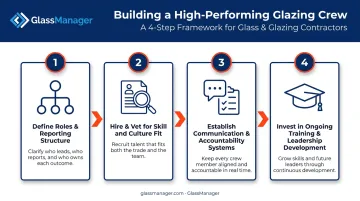
Step 1: Define Roles, Responsibilities, and Reporting Structure
Start by looking at the projects you actually run. A shop doing mostly residential shower enclosures needs a different mix than a commercial glazing outfit handling curtain wall installs.
Common roles to map out:
- Project manager: owns timelines, budgets, and client communication
- Foreman: runs the crew on-site, handles daily coordination
- Estimator: builds quotes and manages vendor pricing
- Installers/glaziers: execute the physical work
Build a simple organizational chart so responsibilities don't overlap or fall through the cracks.
Match skill levels to project complexity: don't put a licensed glazier on a job that only needs general labor, and don't send a helper to a curtain wall job that requires specialty certification. Misallocation like this wastes payroll and slows the job.
Step 2: Hire and Vet for Skill and Culture Fit
With roles mapped out, the next challenge is filling them with the right people. Technical certifications matter, but that's not the whole picture — reliability, communication, and problem-solving under pressure often predict success better than a résumé.
Practical vetting steps:
- Run structured interviews with consistent questions across candidates, not casual conversations
- Use short trial or probationary periods to observe real-world performance before full onboarding
- Check references specifically for reliability, not just skill level
The stakes here are real. FMI's 2023 Talent Study found that construction firms project five-year turnover rates of 22% for executives and 30% for field managers, with 93% of respondents reporting difficulty finding qualified talent. Every bad hire adds to that churn, and every hour spent re-recruiting is an hour not spent running jobs.
Step 3: Establish Systems for Communication and Accountability
Hiring the right people solves only half the problem; keeping them aligned day-to-day is where most crews win or lose. A standardized daily huddle or toolbox talk, paired with a shared digital job board, ensures everyone starts the day knowing the priorities instead of guessing.
Beyond the morning huddle, field management software gives office staff and crews real-time visibility into job status without relying on scattered texts and missed calls.
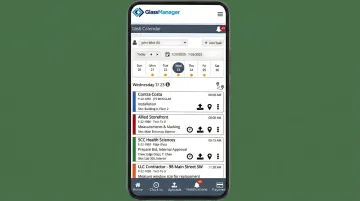
GlassManager, for instance, combines scheduling, CRM, and job tracking in one platform. A scheduling change made in the office shows up on a technician's phone immediately, rather than getting lost in a group chat.
Set measurable KPIs and track them at the individual and team level:
- Safety incidents per crew
- Job completion rate against schedule
- Callback or rework rate
Step 4: Invest in Ongoing Training and Leadership Development
Systems keep a crew aligned day-to-day, but skills still degrade or go stale without reinforcement, especially as materials, codes, and tools evolve. Build cross-training into the schedule rather than treating it as an afterthought.
- Schedule regular sessions on new glazing systems, hardware, or code updates
- Pair experienced crew members with newer hires in a mentorship structure to speed onboarding
- Track OSHA and trade-specific certification renewals to stay compliant and reduce liability
Crews that train together also communicate better on-site, since mentorship naturally builds the informal trust that formal systems can't replicate.
What You Need Before Building a High-Performing Team
Preparation matters as much as the people you hire. Even a skilled crew underperforms without the right systems supporting them.
Roles and Skill Mix Requirements
Determine your minimum crew composition based on typical project size. A standard residential glazing job might need one installer per supervisor, while a commercial curtain wall project could require several installers per foreman. Balance specialized trade skills with general labor — over-staffing a task with specialists wastes payroll, while under-staffing it creates bottlenecks.
Tools, Systems, and Technology Readiness
Centralized scheduling and dispatch prevent the classic problems: job overlaps, no-shows, and double-booked crews.
Platforms built specifically for glass and glazing contractors, like GlassManager, combine CRM, scheduling, mobile field access, and job costing in one system. Office and field teams work from the same data instead of juggling spreadsheets, texts, and separate apps.
For example, GlassManager's shared group calendar lets managers see every crew's assignments across the week, color-coded by status, with automatic notifications whenever a job changes. That kind of visibility is what actually prevents a crew from showing up to the wrong site.
Culture, Safety, and Compliance Readiness
Before a new hire steps onto a job site, document:
- Safety protocols and PPE requirements
- License and certification verification steps
- A written code of conduct shared during onboarding
Setting these expectations early avoids ambiguity later, when it's harder to correct.
Key Factors That Affect Construction Team Performance
Team output isn't just about individual talent— it depends on a set of controllable variables that most contractors can directly influence.
Communication Flow Between Office and Field
Why it matters: Delays and errors often trace back to information not reaching the right person in time. A schedule change the office made at 8 a.m. means nothing if the crew doesn't see it until noon.
Impact on performance: FMI's research, surveying nearly 600 construction leaders worldwide, found that poor project data and miscommunication together caused 52% of rework, costing the US construction industry an estimated $31.3 billion in 2018. The same study found workers lost roughly 14 hours per week to non-optimal activities like hunting for information and resolving conflicts.
Workload Balance and Scheduling Accuracy
Why it matters: Uneven workload distribution burns out some crews while leaving others idle, and both extremes hurt morale and output.
Impact on performance: Workforce shortages compound this problem. AGC's 2024 Workforce Survey of nearly 1,500 contractors found that 54% experienced project delays tied to shortages of their own or subcontractors' workers. Poor scheduling accuracy on top of thin staffing turns a manageable gap into a missed deadline.
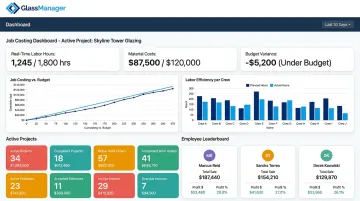
Accountability Through Real-Time Data and Job Costing
Why it matters: Without visibility into labor, materials, and time spent per job, teams lose accountability to budgets and timelines. Nobody notices a job running over until it's too late to fix.
Impact on performance: Real-world results back this up. Rockwall Glass owner Ronnie reported that adopting GlassManager cut paperwork by 70% and freed up more than 12 hours per week, time he redirected straight into billable work. Quality Reflections Glassworks credited real-time analytics with helping the company move "from red to green," turning a consistent profit after struggling with disconnected systems.
Common Mistakes and Troubleshooting Team Performance Issues
Three mistakes show up again and again across underperforming crews:
- Leaving roles undefined causes overlapping work and dropped tasks
- Underinvesting in training leads to skill gaps, safety incidents, and inconsistent quality
- Relying on phone calls and texts instead of a shared system results in missed updates and no accountability trail
Troubleshooting Common Team Issues
Problem: Missed deadlines or recurring job delays Likely cause: unclear scheduling or no real-time visibility into job status. Check: audit your current scheduling process. Does everyone see the same up-to-date timeline, or are people working from outdated information? GlassManager gives every crew member one live schedule instead of separate notes and calls.
Problem: High turnover or low crew morale Likely cause: unclear growth path, poor communication, or inconsistent workload distribution. Check: review onboarding quality, how often feedback happens, and whether workload is actually spread fairly across the team, rather than just assumed to be.
Alternative Team Structures for Construction Businesses
Not every glazing business benefits from a large in-house crew. The right structure depends on project volume and how much specialized expertise you need on a given job.
| Model | When It's Better | Key Trade-Offs |
|---|---|---|
| In-house crew | Consistent project volume, need for tight quality control | Higher fixed labor costs, but greater scheduling reliability |
| Hybrid (core team + subcontractors) | Fluctuating demand, occasional need for niche trade expertise | Lower fixed costs, but added coordination complexity |
A lean operation might run a core team of three or four full-time employees, supplementing with subcontractors during busy seasons.
A GlassManager customer like A Glasco relies on this kind of flexible coordination, handling both commercial and residential workflows while scaling crew size up or down with demand. The result: less time spent on data entry and more time on billable work.
Regardless of which structure you choose, the fundamentals don't change: clear roles, the right systems, and ongoing training determine whether your team consistently hits schedule, budget, and quality targets.
Frequently Asked Questions
What are the 7 stages of construction?
Contractors commonly reference stages like pre-construction, procurement, site preparation, construction, inspection, occupancy, and closeout. The Construction Management Association of America (CMAA) formally groups these into five phases: Pre-Design, Design, Procurement, Construction, and Post-Construction.
What is a construction management team?
A construction management team is the group responsible for coordinating schedule, cost, quality, safety, and scope on behalf of the project owner. CMAA organizes this work across six functions: project, cost, time, quality, contract administration, and safety management.
What's the difference between a general contractor (GC) and a construction manager (CM)?
A GC manages day-to-day construction and subcontractors as the prime builder. A CM's role depends on the delivery model: an agency CM advises the owner without taking on construction risk, while a CM-at-Risk builds the project much like a GC would.
What are the 5 M's of construction management?
The 5 M's (Manpower, Materials, Machinery, Money, and Methods) are a widely referenced framework for the resources a team manages, though they're not an official CMAA or AGC (Associated General Contractors) standard. CMAA's own framework covers six management functions instead.
How do you measure construction team performance?
Common KPIs include job completion rate, rework or callback rate, safety incident frequency (based on OSHA's standardized formula), and schedule variance against the original plan. Track these at both the individual and crew level for the clearest picture.
What is the ideal team structure for a small construction or glazing business?
Small glazing businesses often do best with a lean core team supplemented by subcontractors for specialty or overflow work. Centralized scheduling and communication tools, such as those built into GlassManager, keep this flexible structure from becoming chaotic as job volume shifts.