Introduction
A late glass shipment doesn't just delay one job. It pushes back your install schedule, frustrates the customer, and eats into your margin on the next three projects you had lined up.
For procurement-heavy trades like glass and glazing, supplier reliability is the difference between a profitable quarter and a scramble to explain delays to clients.
Many businesses still track vendor performance through spreadsheets and scattered email threads. That approach worked when you had five suppliers.
It falls apart when you're juggling glass fabricators, hardware distributors, sealant vendors, and freight partners, each with different lead times and pricing quirks.
This guide breaks down the top supplier performance management (SPM) platforms on the market, how to evaluate them, and what smaller trade businesses should weigh before committing to an enterprise-grade tool.
TL;DR
- SPM software tracks and scores vendor performance across quality, cost, delivery, and risk
- Large procurement teams typically need dedicated platforms with automated scorecards and ERP integrations
- Small and mid-sized trade businesses often get more value from an all-in-one platform with built-in vendor and PO tracking
- Prioritize integration capability, automation depth, and total cost of ownership over feature count
- Match the tool to your supplier volume and complexity, not to how many features it lists
Overview of Supplier Performance Management Software
SPM software centralizes supplier data and automates how you measure quality, delivery, cost, and risk against agreed expectations. Instead of chasing down email confirmations or reconciling invoices by hand, the platform tracks performance continuously and flags problems before they snowball.
Supplier networks are getting harder to manage. In Deloitte's 2025 Global Chief Procurement Officer Survey of over 250 CPOs across 40 countries, 74% said diversifying supply sources was their top complexity mitigation strategy, 64% prioritized supplier visibility, and 61% pointed to supplier collaboration. That's a clear signal: manual tracking methods can't keep pace with how sprawling and unpredictable supplier relationships have become.
Some organizations manage supplier counts that would make a spreadsheet collapse under its own weight. Forbes' 2018 analysis of enterprise supplier counts found that P&G worked with more than 75,000 active suppliers, Walmart over 100,000, and Total more than 150,000. Most businesses fall well short of that scale, but the underlying point holds: once your vendor count grows past what one person can track from memory, you need a system.
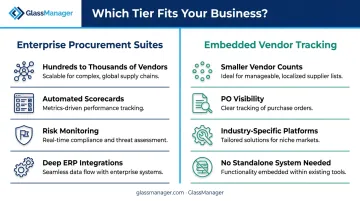
The market splits into two distinct tiers:
- Enterprise procurement suites built for organizations managing hundreds or thousands of vendors, with automated scorecards, risk monitoring, and deep ERP integrations
- Embedded vendor tracking within industry-specific business platforms, designed for smaller operations that need PO and supplier visibility without a standalone system
The list below covers both categories, selected based on automation depth, integration ecosystem, and real market presence.
Best Supplier Performance Management Software
This roundup profiles established enterprise SPM platforms, each with different strengths depending on your procurement complexity and company size. Not every organization needs the same depth of tooling, and that's the point.
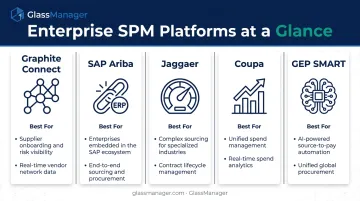
Graphite Connect
Graphite Connect takes a network-based approach. Instead of every buyer re-collecting the same supplier data, it creates shareable "Golden Record" supplier profiles that combine buyer, supplier, and third-party data — cutting down on duplicate entry across organizations.
What sets it apart is the combination of automated risk scoring, AI-powered document scanning that cross-checks tax IDs and certificates for inconsistencies, and rapid onboarding. Graphite reports onboarding speed improvements as high as 70-85% versus manual processes, though these are vendor-reported figures rather than independently verified benchmarks.
| Category | Details |
|---|---|
| Best For | Mid-market to enterprise procurement teams managing supplier risk and onboarding at scale |
| Key Features | Automated risk scoring, network data sharing, ERP integrations, supplier portal |
| Consideration | Built for cross-industry procurement, not tailored to any single vertical |
SAP Ariba
SAP Ariba's supplier performance module sits inside a much broader procurement suite tied to the Ariba Network. Scorecards use weighted question scoring, and organizations can roll up regional or commodity-specific scorecards into a single umbrella view.
The platform stands out for its deep integration with SAP ERP systems through Supplier 360, plus customizable scorecards suited to large, multi-region organizations. If your company already runs on SAP, this module extends naturally into your existing workflows.
| Category | Details |
|---|---|
| Best For | Large enterprises already invested in the SAP ecosystem |
| Key Features | Supplier scorecards, Ariba Network data flow, risk and compliance tracking |
| Consideration | Implementation complexity and cost can be prohibitive for smaller businesses |
Jaggaer
Jaggaer combines performance analytics, configurable dashboards, and supplier collaboration portals into a single view. Its Supplier Snapshot feature gives a 360-degree look at performance, risk, and compliance, with the ability to trigger corrective action plans when scores decline.
The platform's automated alerting is especially strong: predictive signals across financial, operational, and delivery risk help procurement teams stay ahead of problems rather than reacting to them. Jaggaer claims over 1,400 enterprise customers and 13 million-plus suppliers managed across its network.
| Category | Details |
|---|---|
| Best For | Public sector and large procurement organizations with complex sourcing needs |
| Key Features | Configurable dashboards, automated alerts, supplier collaboration tools |
| Consideration | Interface and setup may require dedicated procurement staff to manage effectively |
Coupa
Coupa builds supplier scorecard functionality directly into its broader business spend management platform, pairing automated risk detection with performance monitoring and external data feeds.
What makes Coupa different is its crowd-sourced benchmarking data — anonymized transaction data pulled from thousands of customers gives buyers context beyond their own historical metrics. That said, full scorecard functionality may depend on marketplace add-ons rather than a purely native feature, so it's worth confirming exact capabilities during a demo.
| Category | Details |
|---|---|
| Best For | Organizations wanting supplier performance tied directly to spend management |
| Key Features | Multi-dimensional scorecards, benchmarking, supplier development tools |
| Consideration | Full value depends on adopting Coupa's wider spend management suite |
GEP SMART
GEP SMART leans heavily on AI-driven prediction. Its supplier management agents detect emerging risk patterns and performance shifts, flagging issues before they show up in a quarterly review.
Configurable KPIs by category or region, combined with automated supplier communications, reduce the manual oversight that typically eats up a procurement team's week. GEP cites a Fortune 500 energy company that consolidated 20 separate systems and onboarded roughly 13,000 suppliers using the platform.
| Category | Details |
|---|---|
| Best For | Enterprises seeking AI-driven predictive supplier risk insights |
| Key Features | Predictive analytics, configurable scoring, mobile tracking |
| Consideration | Best suited to organizations with mature procurement data infrastructure |
How We Chose the Best Supplier Performance Management Tools
Our evaluation focused on automation capability, integration depth, scalability, and real-world usability , not just how many features a platform lists on its marketing page.
A common mistake we see: businesses choose an enterprise-grade platform that's overbuilt and overpriced for the actual supplier volume they manage. A 10-person glass shop with 15 vendors doesn't need the same infrastructure as a company running 100,000 supplier relationships.
Beyond analytics sophistication, we weighed:
- Ease of implementation: how quickly a team can get value without a lengthy rollout
- Vendor support responsiveness: because a slow support ticket during a supply chain disruption costs real money
- Fit with existing workflows: whether the tool integrates naturally or forces a parallel process
Supplier Performance Management for Glass & Glazing and Other Trade Businesses
Residential and commercial glaziers manage a fundamentally different kind of supplier network than a Fortune 500 procurement team. You're tracking glass fabricators, aluminum extrusion suppliers, hardware distributors, and sealant vendors — all tied directly to job costing and installation timelines. An enterprise SPM suite built for thousands of vendors and complex compliance workflows is often overkill.
For trade businesses, supplier tracking delivers the most value when it's built directly into the same platform used for purchase orders, job costing, and scheduling. It shouldn't run as a separate system that requires double data entry.
That's the model GlassManager takes. As an all-in-one platform purpose-built for the glass and glazing industry, GlassManager integrates purchase orders directly with estimating, job management, and real-time job costing. The platform also includes a partnership program connecting glaziers with material suppliers and technology providers.
In practice, this looks like:
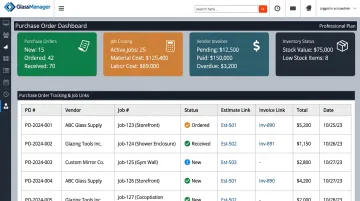
- Purchase orders auto-linked to estimates, so material costs flow into job cost tracking without manual re-entry
- Live dashboards showing PO status at a glance (New, Ordered, and Received) so you know exactly where every order stands
- Vendor invoice reconciliation built into the PO interface, letting you quickly confirm quantities and pricing match what was ordered
- GlassAI quote conversion, which turns vendor quotes directly into customer-ready estimates
This functionality lives in GlassManager's Professional Plan ($95 per user/month, three-user minimum), which also includes inventory management and progress billing tied to the same procurement data.
This approach fits small to mid-sized trade contractors well. Multi-site or high-volume manufacturers with deeper compliance and risk-analysis needs may still require a dedicated enterprise SPM platform on top of their operational software.
Conclusion
The "best" supplier performance management platform depends on your supplier volume, category complexity, and internal procurement resources. An enterprise suite built for thousands of vendors will frustrate a 10-person shop, while a lightweight vendor tracker will buckle under a multinational's compliance requirements.
Before committing, evaluate scalability and total cost of ownership, not just the feature list on a sales page. A platform that looks impressive in a demo but requires a dedicated procurement team to run isn't a win if you don't have that team.
For glass and glazing businesses, that right-sized fit often means a platform built for the trade rather than a generic enterprise suite. GlassManager integrates supplier, purchase order, and job costing tools in one place, showing how vendor tracking can fit directly into everyday estimating and job workflows.
Frequently Asked Questions
How do you manage supplier performance?
Set clear KPIs for quality, cost, and delivery, then monitor performance consistently through scorecards or dashboards. Follow up with structured feedback and corrective action plans when scores decline.
What is SRM, and how does it relate to SAP?
SRM (supplier relationship management) is the strategic, long-term approach to managing key supplier partnerships. SAP is an ERP provider whose Ariba platform offers procurement and supplier performance modules.
What's the difference between supplier performance management and supplier relationship management?
SPM is tactical — it measures day-to-day metrics like quality and delivery. SRM is strategic, focused on long-term collaboration and joint development with key suppliers.
What KPIs should be tracked to measure supplier performance?
Core metrics include quality, cost, and delivery, often called the "golden triangle." Extended metrics like risk score, financial health, and compliance status matter more depending on how critical the supplier category is.
How much does supplier performance management software typically cost?
Pricing varies widely. SAP Ariba's Supplier Lifecycle and Performance module lists at roughly $740 per user per month, while lightweight, embedded tools within existing business platforms cost less overall.
Do small businesses need a dedicated supplier performance management tool?
Not usually. Small and mid-sized businesses managing a limited supplier base often get better ROI from an integrated business platform with built-in vendor tracking, rather than paying for a standalone enterprise SPM system.